
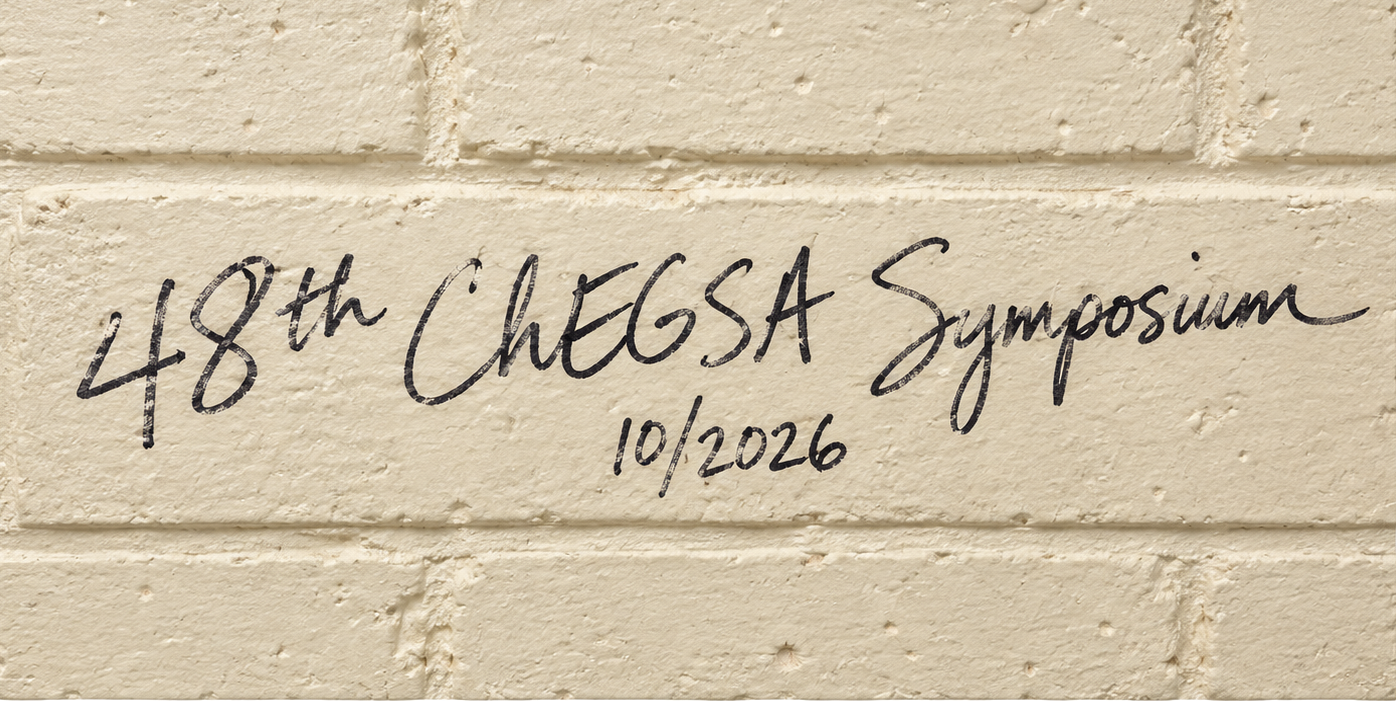
October 15–16, 2026
Doherty Hall | Carnegie Mellon University
Founded in 1979, the ChEGSA Symposium showcases CMU Chemical Engineering graduate research and connects students with faculty, alumni, and industry. The two-day program includes student talks, a poster session, the Lubrizol Keynote Lecture, and a career panel.
Lubrizol Keynote Lecture
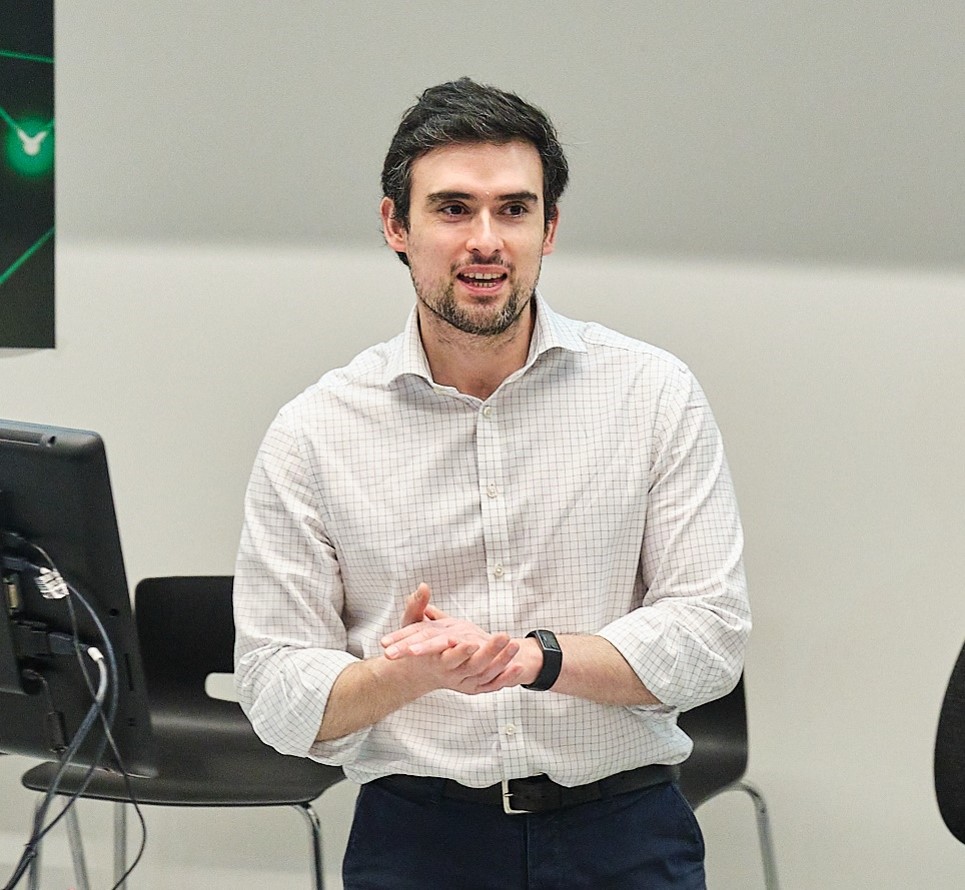
Antonio del Río Chanona
Associate Professor in Chemical Engineering, Imperial College London
Thursday, October 15 | 10:30 a.m.
Machine Learning for Chemical Engineering: From Automated Experimentation to Intelligent Process Control and Large Language Models
Machine learning is increasingly changing not only how we model chemical engineering systems, but also how we design experiments, operate processes, and interact with engineering knowledge. In this talk, I will discuss some of the opportunities that arise when machine learning moves from prediction towards decision-making.
I will first introduce Bayesian optimization as a framework for automated design of experiments, where experiments are selected sequentially to learn efficiently while balancing exploration and exploitation. I will discuss how these ideas can be used in chemical engineering and industrial research, particularly when experiments are expensive, data are limited, or operating constraints must be respected. I will then consider reinforcement learning as a data-driven approach to process control, including applications to complex industrial systems and bioprocesses such as microalgae cultivation.
Finally, I will discuss some of the rapidly emerging opportunities created by large language models and agentic AI in chemical engineering, including systems that can interpret engineering information and automatically construct process simulations from flowsheets and images. Throughout the talk, I will use examples from our research and collaborations with industry to highlight both what these methods can already do and some of the challenges that remain.
Read Antonio’s biography
Antonio del Río Chanona is Associate Professor in Chemical Engineering at Imperial College London, where he leads the Optimisation and Machine Learning for Process Systems Engineering group. He is Co-Director of the Centre for Doctoral Training in Next Generation Synthesis and Reaction Technology and Associate Director for Education at the Sargent Centre for Process Systems Engineering, and research chair of the European Federation of Chemical Engineering for Artificial Intelligence.
His research develops optimisation and artificial intelligence methods for chemical and biological systems, with particular emphasis on Bayesian optimisation, reinforcement learning, hybrid modelling, and large-language-model and multi-agent systems. These methods are applied to autonomous experimentation, bioprocess development, molecular and process design, industrial control, and sustainable chemical value chains.
Antonio received his degree in Chemical Engineering from UNAM and his PhD from the University of Cambridge, where he was awarded the Danckwerts-Pergamon Prize for the best PhD thesis of his year. His distinctions include the IChemE Junior Sargent and Nicklin Medals, an EPSRC Research Fellowship and recognitions from the International Federation of Automatic Control and the European Operations Research Society. He is actively involved in teaching, mentoring and the organisation of international training programmes in optimisation and machine learning.
Schedule
Thursday, October 15
8:30 a.m. Breakfast and registration
9:20 a.m. Opening remarks
Student research talks
9:30 Samantha Yang — Mechanisms of horizontal gene transfer via lipid nanoparticle recycling
9:45 Arsh Bhatia — Graph Neural Networks for Supply Chain Resiliency Mapping
10:00 Shakira Martínez Vásquez — Interfacial Stress as an Environmental Cue for Adaptive Material Assembly by Brucella pituitosa
10:30 a.m. Lubrizol Keynote Lecture — Antonio del Río Chanona
11:45 a.m. Speakers’ Networking Luncheon (speakers and industry guests; by invitation)
Student research talks
1:15 Emerson Uhlig — Mixing oil and water without stirring: a generalized diffusion path theory of spontaneous emulsification
1:30 Amy Apgar — Under-oil Microfluidic Platform for Monitoring Babesia microti Pathogenesis
1:45 Andres Cardenas — Multi-agent Process Design: The role of Game Theory and Reinforcement Learning
2:15 Camila Cue — One Treatment, Four Strains: Electrochemical Therapy Against Multidrug-Resistant Candidozyma auris
2:30 Edwin Lebrón Pérez — Designing Dynamic Bicontinuous Thermosets through Polymerization-Induced Microphase Separation
2:45 Maryam Ali — Influence of electrostatic and non-electrostatic interactions on the partitioning of colloidal particles in polyelectrolyte complex coacervates
3:15 Hannah Schutte — Algal-Based Biopolymers: Design and Synthesis of Spirulina-Derived Cyanophycin Elastomers
3:30 Sergio Bugosen — A Decomposition Approach to Power Grid Capacity Expansion Planning under Operational Uncertainty
3:45 Naseeha Mohammed — Protein Corona Engineering Enhances Lipid Nanoparticle-Mediated RNA Transfection in the Heart
4:00 p.m. Closing remarks
4:15 p.m. Networking reception
Friday, October 16
8:30 a.m. Breakfast and registration
9:20 a.m. Opening remarks
Student research talks
9:30 Ladan Nikfarjam — Post-translational modifications shape tau aggregation behavior and self-assembly
9:45 Robert Maligon Querimit — Automating Process Synthesis for Critical Minerals with Hierarchical Reinforcement Learning
10:00 Sunny Surprenant — Processing-Induced Evolution of Protein Secondary Structure and Mechanical Properties in Dynamic Reprocessable Protein-Based Polymer Networks
10:30 a.m. Panel Conversation: Navigating Career Directions
Antonio del Río Chanona, Jennifer Larimer (Dow), and David Adrian (Dow)
11:45 a.m. Luncheon
12:45 p.m. Poster session
Student research talks
3:00 Jason Yao — Multi-Period Robust Optimization for Designing Membrane Diafiltration Systems Under Operational Disturbances
3:15 Andrew Ashmar — Covalent sidechain modifications modulate self-assembly behavior of amyloid-like fibrils
3:30 Peter Cook — Accelerating emulsion formulation screening through robust and interpretable machine learning
3:45 p.m. Closing remarks
4:00 p.m. Reception and awards ceremony
Judge assignments
Thursday, 9:30 a.m. talks: Jim Schneider and Sebastian Uribe
Thursday, 1:15 p.m. talks: Bob Tilton and Javier Lanauze
Thursday, 2:15 p.m. talks: Sami Mohammed and Steven Iasella
Thursday, 3:15 p.m. talks: Lorenz Biegler and Anna Akkus
Friday, 9:30 a.m. talks: Aisulu Aitbekova and Len Gerlowski
Friday, 3:00 p.m. talks: Ana Ines Torres and David Adrian
Friday poster session: Jennifer Larimer, Crystal Azzarello, Neslihan Cilek, Suryavarshini Sundar, Yousra Timounay, and Derin Sevenler
View the symposium proceedings (PDF)
All sessions are open to registered attendees except where noted.